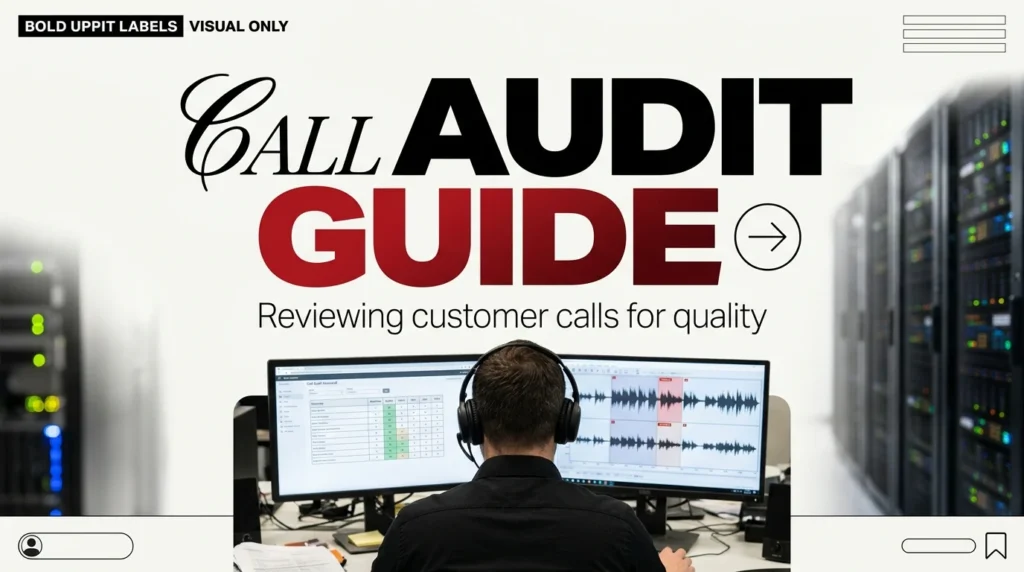
A call audit guide is the written procedure a team follows to review customer calls against fixed criteria: what to score, how many calls to sample, who reviews them, and what happens with the results. Teams that document it get scores that compare across weeks and feedback agents can act on. Teams that skip it get reviewer opinions. This call audit guide covers scorecards, sampling, calibration and the line between what AI can score and what a person must decide.
What Is a Call Audit Guide and Who Uses It?
A call audit is a structured review of recorded or live customer calls against a fixed set of criteria. The guide is the document that makes the review repeatable. It states why the audits exist, who performs them, which calls qualify, how they are scored, and where the findings go.
Four groups use it in practice:
- Quality leads: They own the scorecard, run calibration and report trends.
- Compliance staff: They define the pass or fail items and review any finding that carries legal or contractual weight.
- Team managers: They turn individual call results into coaching conversations.
- Operations owners: They read the aggregate results to spot process problems, such as a policy that confuses agents or a tool that slows resolution.
The guide should name the outputs, because outputs are what justify the effort. Typical ones are agent feedback sessions, compliance findings with a named follow-up owner, scorecard trend reports and a short list of process issues passed to operations. If a step in your audit workflow does not produce one of these, question whether it belongs.
Define which calls are eligible before anyone starts reviewing. Set a minimum call length, exclude wrong numbers and dropped calls, and say how to treat calls that were transferred partway through. Without these rules, reviewers pick different calls for different reasons, and the sample stops being comparable.
Then write the review workflow as numbered steps: pull the call, listen in full, score each item, add a written comment for any item below target, submit, and notify the agent. Include a dispute path. An agent who believes a score is wrong should know whom to ask, how long the answer will take, and who can change the result. A visible dispute process does more for trust in the program than any amount of explanation.
Keep the guide short enough that reviewers actually open it. Define the purpose in a sentence, list roles, link to the current scorecard, state the sampling rules and describe the escalation path. Everything else is an appendix.
How Do You Build a Call Audit Scorecard?
A call audit scorecard is a fixed list of weighted criteria applied to every reviewed call. The word "fixed" matters. If criteria shift between reviews, you cannot say whether an agent improved or the yardstick moved.
Start by splitting the list into two kinds of items, because they behave differently.
| Item type | Scoring | Examples |
|---|---|---|
| Compliance | Pass or fail, no partial credit | Required disclosures, recording consent statement, identity verification |
| Quality | Weighted scale | Greeting, discovery, resolution, tone, call close |
Compliance items should not be averaged into a quality score. An agent who skips a required disclosure has not earned 90 percent for the rest of the call. Report compliance failures separately and route them to whoever owns them.
For quality items, write down what each score means. A rating of 3 on investigation should be described in a sentence or two, with a concrete behavior, such as "asks at least two questions about the issue before proposing a fix." Without anchors, two reviewers will read "good" differently. Write the anchors for the top and bottom of the scale as well, so a reviewer knows what a 5 and a 1 look like, not just the middle.
Weight items by their effect on the customer outcome. Resolution usually deserves more weight than greeting style. Score behaviors the agent controlled, not the result of the call. An agent who followed the process correctly on a refund the policy forbids should not lose points for the customer's disappointment. Require a short written comment on every item scored below target, naming the moment in the call. A timestamp makes the comment usable in coaching.
Keep the call audit guide and scorecard stable
Limit the scorecard to the criteria you will coach on. Fewer than a dozen scored items is a reasonable ceiling for most teams, since reviewers lose consistency as lists grow. Change the scorecard on a schedule, for example quarterly, version it, and note the version on every result. When you do change it, mark the break in your trend reports so nobody compares scores across two different definitions. Also update the scorecard when a policy changes. An item that still rewards the old procedure teaches agents the wrong behavior.
How Many Calls Should a Team Sample and How Often?
Sampling is a fixed number of calls per agent per period, chosen so the sample is large enough to show patterns rather than one bad afternoon. There is no universal number. A workable starting point for many teams is a handful of calls per agent each month, raised for new hires and lowered only when results prove stable. Set the figure against reviewer capacity, then keep it constant so agents are treated alike.
Do the arithmetic before you commit. As an illustration, a team of 20 agents sampled at 4 calls each needs 80 reviews a month. Multiply that by the average review time, including comments, and compare the total with the hours your reviewers actually have. If the numbers do not fit, shrink the scorecard or the sample. Do not let reviewers quietly skip calls, because skipped calls bias the results.
Random and targeted sampling
Use both, and label which is which in your records.
- Random: Pull calls by a rule, not by reviewer taste. This gives an unbiased view of typical performance.
- Targeted: Add calls that carry known risk, such as flagged calls, escalations, complaints, long handle times and calls from agents in their first weeks.
Do not blend the two when reporting an agent's average. A set of escalated calls will score lower than a random set, and that says little about the agent.
Rotating samples
Rotate across call types, queues, shifts and days of the week so one agent is not always reviewed on the same easy contact reason. If you have a call type that matters most, such as cancellations or billing disputes, reserve a quota for it inside the sample.
Calibrating reviewers
Calibration is how you find out whether your scorecard works. Have every reviewer score the same call independently, then compare results item by item. Where scores diverge, the criterion or its score definition is usually ambiguous, so fix the wording rather than arguing about the call. Choose calls that are hard to score, not clear-cut ones, since easy calls hide disagreement. Hold the discussion only after everyone has submitted, so no one anchors on the loudest voice. Run calibration on a regular schedule, and always after a scorecard change or when a new reviewer joins. Record the gap between reviewers over time. If it widens, your results are drifting.
Where Does AI Fit Into Call Auditing?
AI is most useful for scoring high volumes of calls against clear, repeatable criteria. A human team might review a few calls per agent. Automated scoring can cover every call, which turns sampling from a necessity into a choice and lets reviewers spend their time on judgment.
| Task | AI | Human reviewer |
|---|---|---|
| Keyword and phrase checks, such as a required disclosure | Reliable first pass | Confirms wording was in context |
| Silence and talk-over | Reliable | Judges whether it mattered |
| Sentiment trends across calls | Useful for patterns | Checks outliers |
| Sarcasm, humor, ambiguity | Weak | Decides |
| Policy nuance and exceptions | Weak | Decides |
| Cross-language or mixed-language calls | Uneven | Reviews, ideally a fluent speaker |
Sentiment scoring deserves care, since the method behind a score shapes what it means. Our guide to AI customer sentiment analysis covers how sentiment is measured and where those measurements break down.
AI struggles where meaning depends on context. A customer who says "great, thanks a lot" may be pleased or furious. A policy exception granted by a supervisor looks like a violation to a model that only knows the standard rule. Calls that switch languages midway can produce unreliable transcripts, and every downstream score inherits the error.
That is why a person should confirm any compliance finding before it reaches an agent or a regulator. A false positive wastes an agent's trust. A false negative leaves risk in place. Treat AI output as a ranked queue for reviewers, not a verdict. If you formalize AI scoring, the NIST AI Risk Management Framework offers a useful vocabulary for documenting how you test, monitor and govern the system. Also spot-check AI scores against human scores on the same calls, using the same calibration habit you use for people.
Roll it out in stages. Start with one or two objective criteria, such as the recording consent statement, and run the AI score alongside your human reviews for a few weeks. Compare the results call by call and log every disagreement with its cause. Only expand to subjective items once the objective ones hold up. Set a flagging threshold deliberately, since a low one floods reviewers and a high one misses real problems. Keep a record of the model version, the transcript source and the date of each change, so a shift in scores can be traced to a cause.
What Mistakes Make Call Audits Fail?
Most failed call audit programs break on unclear criteria, inconsistent reviewers, or audit results that never reach the agent. The scorecard may be fine. The process around it is what fails.
- Too many criteria: Long scorecards produce shallow, inconsistent scoring and feedback nobody can absorb. Cut anything you will not coach on.
- No calibration: Without it, an agent's score depends on who happened to review the call.
- No named owner for follow-up: Findings sit in a spreadsheet. Assign one person to each finding type and set a date for the response.
- Scores used only for discipline: Agents learn to fear audits and stop trusting the numbers. Use results mainly to coach, and keep disciplinary action tied to documented compliance failures.
- Scoring the outcome instead of the behavior: Reviewers mark down a call because the customer was upset, even when the agent followed the process. Score what the agent did.
- Unchecked recording and retention practices: Teams audit calls they were never clearly allowed to record, or keep them longer than policy permits. Consent requirements differ by state and country, and some contact types, such as telemarketing, carry their own recordkeeping rules. Review your practices with counsel and read guidance from bodies such as the U.S. Federal Trade Commission where it applies to your calls.
The most common quiet failure is the gap between a score and a conversation. A result that does not lead to a coaching session within a short, defined window is just a record. Feedback delivered weeks after the call is hard to connect to anything the agent remembers, so state the window in the guide and have managers report against it. Once your audits produce reliable scores, the next step is deciding how to deliver them. Our comparison of agent coaching software tools is a good place to start when you are ready to turn audit results into coaching.
Call Audit Guide FAQs Buyers Ask Most
How long should a call audit take per call?
Budget the length of the call plus a few minutes for scoring and written comments. Reviewers can skim silent stretches, but compliance items need careful listening. If scoring takes far longer than the call itself, the scorecard is probably too long. Track time per review during calibration and adjust the sample size to fit capacity.
Who should own the call audit process inside a company?
One accountable person, usually the quality lead or contact center operations manager, should own the scorecard, sampling rules and calibration. Compliance should own the pass or fail items, and team managers should own coaching follow-up. Shared ownership with no single name tends to mean nobody acts on the findings.
Do call recordings need consent before they are audited?
It depends on where you and your customers are located, since consent rules vary by jurisdiction. Many teams open calls with a recording notice for that reason. Confirm the requirements with legal counsel, and make sure your recording, storage and retention practices match them before you build an audit program on top.
Should AI scores replace human call reviews?
No. Use AI to cover volume and surface calls worth a closer look. Keep people responsible for context, policy exceptions and any compliance finding. The strongest setup pairs automated scoring of every call with human review of flagged calls, plus regular checks that AI and human scores agree.

Palak Bhalgami
Palak Bhalgami manages the design and deployment of custom AI agents across enterprise clients in manufacturing, pharma, and logistics. He specializes in scoping AI projects, bridging technical and business teams, and ensuring smooth implementation and team adoption.
See full bio and all articles