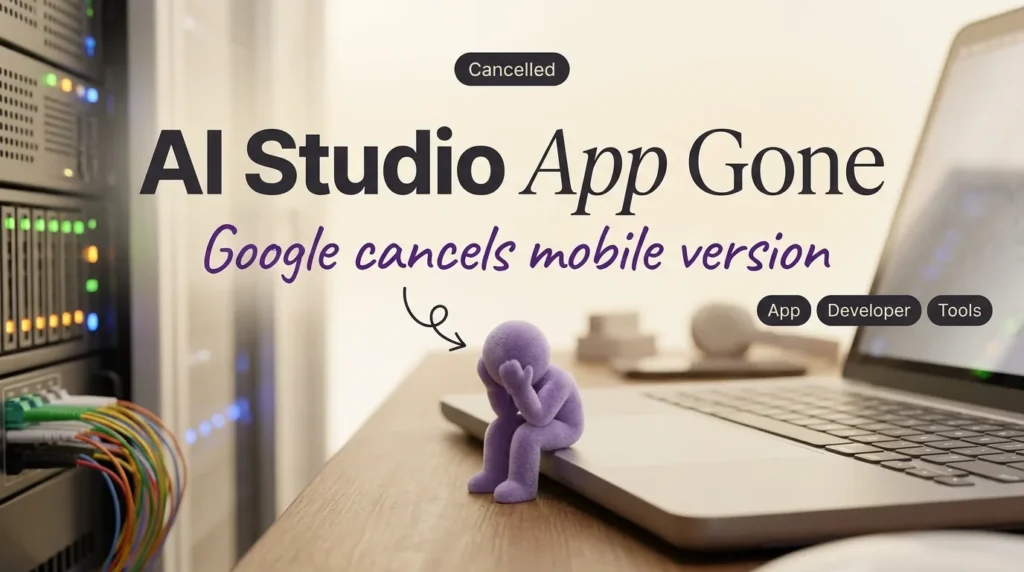
Google confirmed on July 31, 2026 that it was dropping the standalone AI Studio app for Android and iOS, a day before its expected August 1 launch. The browser version of Google AI Studio was not part of that decision, and the app-building tools are meant to move into the Gemini app, though Google has given no date.
This post sorts what was cancelled, what still runs, and what you should verify before you commit a project to the platform.
Google Scrapped the Standalone AI Studio Mobile App on July 31, 2026
The facts are short. Google announced the AI Studio mobile app at I/O 2026 and opened pre-registration on May 19. The pitch was that you could iterate on code and preview builds from your pocket. Store listings went up for both Android and iOS, and the launch was expected on August 1.
On July 31, Google confirmed it was scrapping the standalone app. The store listings were pulled as well, so there is nothing to install and nothing to wait for. The cancellation applies to the separate mobile product only.
The demand figure is the part that makes this odd. Google itself cited roughly 800,000 pre-registrations across more than 168 countries as proof that people wanted to build software on the move. That number was used to promote the app, and the app was then cancelled. If you were one of those registrants, your registration did not convert into anything. No launch notification is coming for a product that no longer exists.
What Was Dropped and What Was Not
| Item | Status as of November 2026 |
|---|---|
| Standalone AI Studio app for Android | Cancelled, listing pulled |
| Standalone AI Studio app for iOS | Cancelled, listing pulled |
| Pre-registration | Closed with the listings |
| Browser version at aistudio.google.com | Live |
| App-building tools inside the Gemini app | Planned, no date given |
Treat the table as a sorting aid, not a product roadmap. Only the first three rows are settled. The last row is an intention.
One practical point for teams that had already written the app into plans: any workflow that assumed a native phone client for prompt iteration and build previews now has no first-party equivalent. The nearest option is the browser version on a mobile browser, which Google never positioned as the replacement.
Why Google Dropped the AI Studio Mobile App Remains Partly Unexplained
Google has tied the app-building tools to the Gemini app, but it has not published a full reason for dropping the standalone app. That gap matters, because it leaves you guessing at motives that should not drive your technical decisions.
What the Public Statements Say
Google confirmed the cancellation. Reporting around it indicates the features from the standalone app are to be folded into the Gemini app. That is the stated direction, and it is the only one.
What They Do Not Say
Google has not given a specific timeline for when the app-building tools will go live inside Gemini. It has not said which features carry over, in what form, or to which subscription tiers. It has not said whether the code preview and build iteration that defined the AI Studio app will survive intact. And it has not explained why a product with a public demand figure was pulled a day before launch.
Confirmed Facts Versus Inference
Keep these in two columns when you brief your team.
- Confirmed: The standalone app was announced on May 19, cancelled on July 31, and removed from the stores.
- Confirmed: Google cited about 800,000 pre-registrations in more than 168 countries.
- Confirmed: The app-building tools are slated to move into Gemini, with no timeline.
- Inference: Consolidating into one consumer app is easier to support than two. This is plausible and unstated.
- Inference: The Gemini app will get a feature set similar to the one demoed at I/O. Nobody has confirmed it.
Inference is fine for forming a view. It is not fine for a schedule. If a plan says “mobile build tools ready in Q1” and the only basis is a reasonable guess about Google’s intent, rewrite the plan.
There is also a pattern worth noting without overreading it. Google announced a product at a flagship event, collected sign-ups, and withdrew it at the finish line. That is a reminder that a pre-registration page is a marketing instrument, not a commitment. Weigh preview-stage announcements accordingly, here and with any other vendor.
What Happens to the AI Studio Browser Version and App-Building Tools
The browser version is fine. An August 21, 2026 report from the vendor Thunai said the browser version at aistudio.google.com was still live and still funded. The same report said developers can now deploy managed agents straight from the interface through the Interactions API. The Google AI Studio browser version is where Google is putting new capability, not where it is winding things down.
That reading matters because the word “cancelled” in headlines invites a wrong conclusion. Cancelling the phone client did not reduce the web product. If anything, the managed agent deployment suggests the browser surface is still gaining features.
The App-Building Tools Have No Date
On August 4, reporting noted that Google had not shared a timeline for the app-building tools going live inside Gemini. As of late November 2026 you should assume that remains the position unless Google says otherwise. Three months of silence is not a signal either way, but it does mean you cannot put a launch window in a plan.
The sensible approach is to split your dependencies:
- Safe to build on today: Model access, prompt testing, and agent deployment in the browser version.
- Safe to watch: App-building inside Gemini, as a possible future convenience.
- Unsafe to schedule: Anything that requires the Gemini app to expose build and preview tools by a specific date.
What to Check Before You Build
Before committing a project, confirm these in the product itself rather than in coverage:
- That the features your prototype uses are present in the browser version today.
- That your project export or code handoff does not depend on a mobile surface.
- That the models you need are listed in the Gemini API documentation and not just in the interface.
- That you have a fallback path if a preview feature changes or disappears.
The last item is the one teams skip. If a prototype lives only inside a vendor’s playground, you have a demo, not an asset. Moving the working logic into your own repository and your own API calls is the cheap insurance. If you want help doing that, our AI product development services cover taking a prototype and making it a maintainable product.
Google AI Studio Browser or Gemini App: Which Fits Developers Now
For development work, use the browser version. It gives you model access, a playground for testing prompts, and the managed agent route. The Gemini app is built for everyday use, and app-building there is not confirmed.
| Factor | AI Studio in the browser | Gemini app |
|---|---|---|
| Primary purpose | Building and testing with model access | Everyday assistant use |
| Status | Live and funded | Live as a consumer app |
| App-building tools | Available in the browser | Planned, not confirmed, no date |
| Agent deployment | Managed agents via the Interactions API | Not announced |
| Planning confidence | High | Low for developer features |
A Practical Rule
Build and test in the browser version. Treat Gemini app features as roadmap items until Google announces them. When an announcement arrives, check three things before you change anything: the date the feature is available, which accounts and tiers get it, and whether it exposes the same model and API controls you rely on now.
Where This Leaves Mobile Workflows
If your team wanted to review builds from a phone, you have workarounds but no polished answer. The browser version opens on mobile, with the usual compromises of a desktop-first interface. For code review and light prompt edits that may be enough. For real iteration, it is not what the cancelled app promised.
This is also a good moment to separate tool choice from strategy. Whichever Google surface you favor, the durable decisions are about architecture: where your prompts live, how you version them, and how quickly you could swap a model. Our write-up on technology consulting services for AI automation strategy covers how to frame those choices so a vendor reshuffle does not become your emergency.
Developers Should Plan Around Gemini 4 Access and Playground Errors
The model picture in late November 2026 is active and uneven. New access is arriving, and reliability is not yet steady for every model.
Genie 4 Reached Developers on November 19
Google opened Genie 4 to developers through the Gemini API and AI Studio on November 19. Eligible Ultra subscribers had received access a day earlier through Project Genie. If you hold an Ultra plan, you saw it first. Everyone else got it through the developer route.
Argon and Neon Errors in the Playground
On November 23, paid users reported timeouts and “model-unavailable” errors for the Argon model in the AI Studio Playground. Later that day the reports expanded to include timeouts with Neon as well. These are user reports, not a Google status notice. They describe a pattern, not a diagnosis, and they say nothing about how long the problem lasts.
What to do about it:
- Add retries: Use exponential backoff on any call that can time out.
- Add a fallback model: Route to another available model when you get a model-unavailable response.
- Log the errors: Record the model name and error type so you can separate your bugs from platform issues.
- Test outside the Playground: Compare a direct API call with the same request in the interface to see whether the fault is in the UI layer.
Gemini 4 Neon Is Reported, Not Announced
Gemini 4 Neon was reported live in AI Studio on November 18, based on a post on X. Google had not made an official announcement, and API availability was not confirmed in the latest reports. Do not build a release on it. Check the Gemini API documentation for the model list, and treat a model absent from that list as unavailable to your production code regardless of what the interface shows.
The older Gemini 3.1 Pro preview mentioned in earlier roundups has been superseded by the Gemini 4 family of Argon, Carbon, Hydrogen and Neon, so refresh any internal docs that still name it.
Google AI Studio App Cancelled FAQs Readers Ask Most
Did Google Shut Down the AI Studio Website?
No. Only the standalone mobile app for Android and iOS was cancelled. The browser version at aistudio.google.com remains live and was reported as still funded in August 2026, with managed agent deployment added through the Interactions API.
Will the AI Studio App-Building Tools Come to the Gemini App?
That is the stated direction, but Google has not given a timeline. Until it announces availability, treat the Gemini app version as a roadmap item and keep your build work in the browser version.
Why Were People Pre-Registering for the AI Studio Mobile App?
Google promoted it as a way to iterate on code and preview builds from your phone. Around 800,000 people across more than 168 countries had pre-registered, a figure Google cited as proof of demand for building software on the move.
Is Gemini 4 Neon Available Through the Gemini API?
It has not been confirmed. Neon was reported live in AI Studio on November 18 based on a post on X, but Google had not officially announced it or confirmed API availability in the latest reports. Check the Gemini API documentation before depending on it.
Why Are Argon Model Requests Failing in the AI Studio Playground?
Google has not published a cause in the reports available to us. Paid users reported timeouts and model-unavailable errors for Argon on November 23, and later reported timeouts with Neon too. Add retries and a fallback model while the problem persists.

Gaurav Choudhary
Gaurav Choudhary oversees delivery and operations at Source Code Lab, ensuring AI agents integrate seamlessly into client workflows and scale reliably in production. His expertise spans coordinating multi-agent systems, complex enterprise integrations, and post-launch optimization across diverse industries.
See full bio and all articles