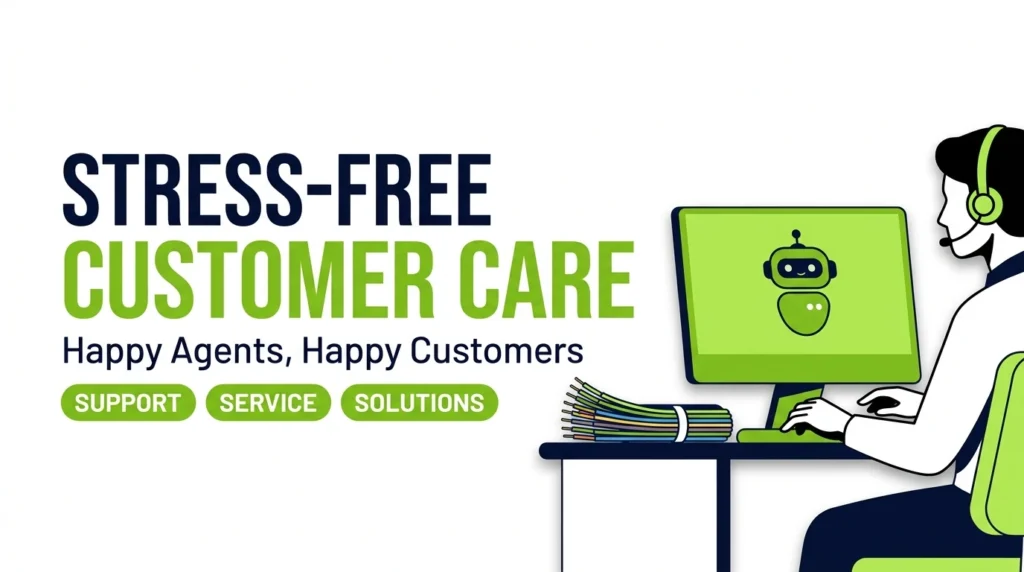
Good customer care resolves the problem the customer actually has, quickly and honestly, and it leaves a clear path to a person when automation falls short. The best-known examples work because of repeatable systems and frontline judgment, not famous gestures. This post checks each widely quoted example against 2026 figures, marks the ones that are out of date, and ends with a buyer-side checklist for AI-assisted care.
What Makes Customer Care Good in Practice?
Good customer care is a resolved problem, delivered fast, with no spin. Politeness helps, but it is not the test. The test is whether the customer's real issue is gone when the contact ends, and whether they had to fight to get there.
Four traits recur across the strong examples:
- Listening before acting: The agent confirms what the customer needs before offering a fix, which avoids solving the wrong problem.
- Owning the outcome: One person or one system holds the case until it is closed, rather than passing it along.
- Fast resolution: Speed counts, but only when the answer is correct. A quick wrong answer creates a second contact.
- A clear path to a human: The customer can reach a person without repeating the story, especially after automation has failed.
National benchmarks show why these traits matter now. The American Customer Satisfaction Index put US customer satisfaction at 76.1 out of 100 in Q2 2026, down from 76.9 a year earlier. In the UK, the Customer Satisfaction Index stood at 78.3 out of 100 in July 2026, up one point over the year. So the US trend is slipping slightly while the UK is nudging up.
Read those numbers with care. Sources do not always use the same baseline. One source describes the US drop against Q4 2025 instead of the year-earlier quarter, so the size of the decline depends on which comparison period you pick. If you cite the figure in a board deck or a vendor evaluation, state the period alongside it.
The cost of getting care wrong is real. PwC's 2025 survey found that 52% of US consumers stopped using or buying from a brand after a bad experience with its products or services. That is the number every example below is trying to avoid.
Which Brands Show Good Customer Care, and What Can Be Copied?
Amazon and Apple are the most cited brands, and their value lies in repeatable systems rather than single heroic acts. You can study the systems. You cannot copy a story.
Amazon is usually praised for two habits: a returns process that treats the customer's claim as the starting point, and delivery-status visibility that answers "where is my order" before the customer has to ask. The lesson is about removing reasons to contact support in the first place. We are describing the pattern at a general level here. Check Amazon's current policy pages before you build anything around specific return windows or terms.
Apple is usually cited for its escalation paths. A customer can move between in-store help and phone support, and the problem is meant to travel with them. Again, the copyable part is the structure: more than one channel, and a defined way to move up a level without starting over. Confirm current service details directly with Apple rather than relying on a ranking page.
Many listicles also lean on older stories. Here is how to treat the common ones as of November 2026:
| Example | What is usually claimed | How to treat it |
|---|---|---|
| Ritz-Carlton | Staff can spend up to $2,000 on the spot to fix a guest's problem | A 2009 figure from a Forbes interview, not a confirmed current policy. Historical context only. |
| Zappos | Support calls have no time limit | Drawn from 2010 to 2016 reports. Historical context only. |
| Chewy | Personal, empathetic service touches | Comes from 2024-era articles. Verify before citing as current. |
| Trader Joe's | Store-level helpfulness and staff autonomy | Comes from 2024-era articles. Verify before citing as current. |
The Ritz-Carlton and Zappos cases still teach something. Both show the value of giving frontline staff real authority and time. But a figure from 2009 tells you nothing about what a hotel group allows today, and a call model reported years ago may have changed. Present them as origin stories, not benchmarks.
The same caution applies to forecasts. Gartner predicted that organizations would replace 20% to 30% of service agents with generative AI by 2026. That target year is nearly over, so treat the claim as a forecast to test against your own data, not as a result.
How Does Frontline Judgment Turn a Bad Moment into Good Care?
A frontline employee who listens, then acts on what the customer needs, can change the outcome of a bad moment. The act itself can be small. What matters is that it fits the person in front of them.
A United Airlines example, reported in 2025, shows the pattern. A passenger on a San Francisco to Chicago flight was distressed. The flight attendant listened carefully first. Then she brought him a ginger ale and tissues, and later a warm cookie. Nobody scripted those items. She read the situation and responded to it in stages.
Why do small, timely acts often beat a scripted apology? A script tells the customer the company has a policy for feelings. A specific act tells them someone noticed. The ginger ale addressed a physical need. The tissues acknowledged the emotion without commenting on it. The cookie came later, which signaled that the attention had not stopped once the immediate crisis passed.
Speed and honesty matter here too. A 2025 Metric Sherpa survey released by Sprinklr found that consumers named a fast, honest resolution as the top way a brand could recover loyalty after a bad experience, at 23%. Compensation came second, at 21%. The flight attendant's response fits that pattern. It was prompt, it was sincere, and it did not try to buy the passenger's goodwill.
Now the limit. This example describes one employee's judgment on one flight. It is evidence of a pattern you can build around, not a policy to copy whole. You cannot instruct every agent to hand over a cookie. You can do these things:
- Train agents to listen and confirm the need before proposing a fix.
- Give them a defined range of discretion, so small gestures do not need approval.
- Review cases where an agent used judgment well and share the reasoning, not just the outcome.
That turns an anecdote into a habit, which is the only version of it that scales.
Should Good Customer Care Use AI, and Where Does It Break?
AI can handle routine contacts well, but the handoff to a person is where most good care fails. The tools themselves are rarely the weak point. The seam between the tool and your agents is.
Adoption is moving fast. In Salesforce's survey of 3,075 service professionals, AI agent adoption in service organizations rose from 39% in 2025 to 66% in 2026. Customers are not keeping pace with that enthusiasm. A Gartner survey of 3,566 B2B and B2C customers, fielded February to March 2026, found that 58% of US consumers are only somewhat or not at all comfortable using AI tools to interact with brands. You are rolling out a channel that a majority of consumers still approach with caution. For further background, see Gartner customer service research.
The failure shows up at the handoff. In April 2026, Gartner reported that 90% of CX decision-makers using AI had hit challenges with AI-to-human handoffs, including disconnected workflows. In practice, that looks like this:
- The customer explains the issue to a bot, then explains it again to an agent.
- The agent sees a transcript but not the actions the bot already took, such as a refund attempt or an account lookup.
- The case lands in a general queue instead of with someone who can resolve it.
- The customer cannot find the option to reach a person at all.
Each of these breaks the traits from the first section. Lost context destroys listening. A queue with no owner destroys ownership. A hidden exit destroys the clear path to a human. If you are weighing automation, treat the handoff as a design requirement, not a later phase. Our post on keeping humans in the loop covers how customer experience leaders approach that balance.
What Checklist Helps Teams Copy Good Care Without Copying Its Scale?
Teams can reproduce good care by setting clear resolution speed, honest explanations, and a human escalation trigger before scaling any automation. You do not need Amazon's operation. You need its discipline about what happens when something goes wrong.
Use this checklist when you evaluate a vendor, build a workflow, or audit your current setup:
- Define the handoff trigger: Write down the conditions that move a customer to a person. Examples include repeated failed attempts, a stated request for an agent, high-value accounts, and strong negative sentiment. Do not leave it to the model's confidence alone.
- Pass full case context: The agent should see the customer's issue, the steps already tried, any actions the AI took, and the customer's account details. Test this by asking an agent to take over a live case and timing how long they need to get oriented.
- Set a time-to-resolution target: Pick a target per contact type, and measure resolution, not just first response. Fast and wrong does not count.
- Decide what compensation is allowed: Define what agents can offer without approval. Remember that in the Sprinklr-cited survey, a fast, honest resolution (23%) edged out compensation (21%) as the top loyalty-recovery method. Compensation supports a good resolution but does not replace one.
- Name the owner: Every case should have one accountable person or team from open to close, including cases that started with a bot.
- Measure after the fix: Track how customers feel once the case is closed. Our guide to AI customer sentiment analysis explains how to read that signal at scale.
One more warning before you build a business case. A Convot audit published in October 2026 examined the 10 most-quoted customer service statistics. Only 2 traced back intact to their original study. Three were misquoted, two were stale, and three could not be traced at all. Trace any number to its original study and its date before you put it in a report. If you cannot find the study, leave the number out.
Good Customer Care Examples FAQs Buyers Ask Most
How Can a Company Tell Whether Its Customer Care Is Actually Good?
Check whether problems get resolved on the first contact, how long resolution takes, and how often customers have to repeat themselves. Add post-resolution sentiment and repeat-contact rates. National indexes such as the ACSI give context, but your own case data tells you more.
Which Customer Care Statistics Are Safe to Quote in a Report?
Only the ones you can trace to the original study, with its date and sample. A Convot audit found just 2 of the 10 most-quoted customer service statistics traced back intact. Quote the primary source, state the survey period, and drop any figure you cannot verify.
When Should an AI Support Tool Hand a Customer to a Human Agent?
Hand off when the customer asks for a person, when the tool fails to resolve the issue after repeated attempts, when the account or issue is high stakes, or when sentiment turns clearly negative. The handoff should carry the full case context so the customer does not start over.
Does a Fast, Honest Resolution Repair Trust Better than Compensation?
The evidence points that way, though narrowly. In a 2025 Metric Sherpa survey released by Sprinklr, consumers ranked fast, honest resolution first at 23%, with compensation second at 21%. The gap is small, so treat compensation as a useful addition rather than a substitute.
Frequently asked questions
Compare your satisfaction scores against a published national benchmark, such as the American Customer Satisfaction Index, which stood at 76.1 out of 100 in Q2 2026. Check that the period and method match before drawing conclusions. Repeat contacts and resolution time often reveal more than a single satisfaction score.
Only statistics you can trace to the original study are safe to quote. A 2026 audit by Convot found only 2 of the 10 most-quoted customer service statistics trace back intact, with 3 misquoted, 2 stale, and 3 untraceable. Open the primary survey before reusing a figure.
Hand off when the customer asks for a person, when the issue involves money, legal exposure, or a safety concern, or when the AI fails twice to resolve the same request. Transfer the full conversation history so the customer does not repeat themselves. Gartner's 2026 survey found 90% of CX decision-makers using AI reported handoff challenges, so test this path before launch.
In a 2025 Metric Sherpa survey released by Sprinklr, a fast, honest resolution was the top way consumers said a brand could recover loyalty after a bad experience, at 23%. Compensation ranked second at 21%. Honesty about what went wrong and how it will be fixed counts for more than the size of the offer.

Gaurav Choudhary
Gaurav Choudhary oversees delivery and operations at Source Code Lab, ensuring AI agents integrate seamlessly into client workflows and scale reliably in production. His expertise spans coordinating multi-agent systems, complex enterprise integrations, and post-launch optimization across diverse industries.
See full bio and all articles