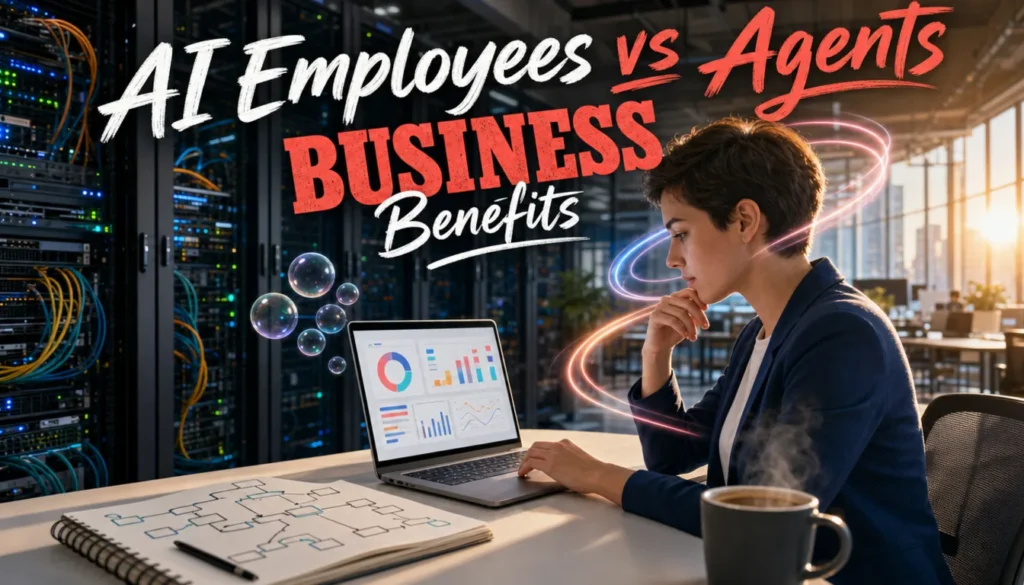
What Are AI Employees and AI Agents, and How Do They Differ?
An AI employee is a packaged system assigned a defined business role and workflow. An AI agent is a software component that plans and takes actions toward a goal. We use those two names throughout, and nothing else, so the comparison stays clean.Scope of ownership versus unit of capability
The difference is not intelligence or the underlying model. It is scope. An AI agent is a unit of capability: it reads an invoice, classifies a ticket, drafts a reply, or queries a system and decides what to do next. It does that one thing well, and someone else decides when it runs and what happens with its output. An AI employee is a unit of ownership. It is given a role, such as accounts receivable follow-up, and it carries the workflow from trigger to outcome: pulling the aging report, deciding who to contact, sending the message, logging the response, and escalating exceptions. It has an owner on your side, a defined set of systems it touches, and a point at which a person takes over. A useful test: after launch, who is accountable for the result of the workflow, not just the correctness of one step? If the answer is the system itself, with a named human supervising it, you are looking at an AI employee. If the answer is a person or another system that calls the component when needed, you have an AI agent.Why the two overlap
The terms blur because an AI employee is often built from several AI agents. An order-tracking AI employee might use one agent to read supplier emails, another to match them to purchase orders, and a third to draft customer updates, all coordinated by workflow logic and permissions that define the role. The agents are the parts. The AI employee is the assembled role, plus the rules around it: what it may do alone, what needs approval, and how its work is logged. That is why vendor pages use the words interchangeably. For a buyer, the distinction matters because it changes what you are buying: a capability to wire into your own process, or a function you hand over and supervise.How Do AI Employees and AI Agents Compare Side by Side?
An AI employee suits a recurring business function that needs end-to-end ownership, and an AI agent suits a narrower task inside a larger system. The table puts both next to a build partner so you can see where each fits.| Option | Scope | Autonomy level | Integration effort | Ownership after launch | Best fit |
|---|---|---|---|---|---|
| AI agent | One task or decision inside a workflow | Acts toward a goal within a narrow boundary; a person or system decides when it runs | Lower: connects to one or a few systems | The team or system that calls it | Classifying, routing, extracting, flagging, drafting |
| AI employee | A whole role or recurring function, start to finish | Runs the workflow on its own within set limits; escalates exceptions to a named person | Higher: touches several systems, data sources and approval paths | A named internal owner who supervises results | Recurring multi-step functions such as receivables follow-up or order tracking |
| sourcecodelab.ai | B2B software and services firm that builds custom AI agents and automation for operations | Set per engagement, from single-task agents to multi-step workflows | Scoped against your existing tools during the build | Agreed at handover; your team should name the owner | Companies that want AI agents or an AI employee built around their own operations |
Reading the table
The rows are not rivals. The first two are patterns; the third is a way to obtain either one. If you need a custom build rather than an off-the-shelf product, a services firm sits in the buying path regardless of which pattern you choose. Integration effort is where budgets drift. An agent that classifies documents needs access to the document store and a place to write its label. An AI employee that runs collections needs read access to the ledger, send access to email, write access to the CRM, and a rule set agreed with finance on what it may offer a customer. Each connection adds testing, permissions and a failure mode. Ownership after launch is the row most buyers skip. An agent embedded in a process is usually maintained by whoever owns that process. An AI employee needs an explicit supervisor, someone who reviews its exceptions, updates its rules when policy changes, and notices when its output drifts. If you cannot name that person before the build starts, you are not ready to buy an AI employee.Which Use Cases Suit an AI Employee and Which Suit an AI Agent?
Recurring, multi-step functions such as accounts receivable follow-up, HR and payroll operations, or order tracking suit AI employees, while single decisions such as routing a ticket, classifying a document, or flagging an anomaly suit AI agents.AI employees for business: functions that need an owner
Look for work that repeats on a schedule, crosses two or more systems, and has a clear definition of done. If a person currently spends part of every week chasing, reconciling or updating, that is a candidate role. If the work is one judgment call buried in a longer process, that is a candidate agent.Use cases by industry
Manufacturing. An AI employee can own supplier order tracking: reading confirmations, matching them to purchase orders, and warning planners about late shipments. The workflow owner is the procurement lead; the human checkpoint is approval before any expedite request or supplier change. An AI agent fits a narrower job, such as flagging a sensor reading that departs from a line's normal range, with the maintenance supervisor deciding what to do. Pharma. An AI agent can classify incoming documents, such as supplier certificates or batch records, and extract fields for review. The owner is the quality or regulatory operations lead, and a qualified person signs off on anything that feeds a regulated record. A full AI employee role here needs tighter validation and audit trails, so scope it cautiously. Oil and gas. An AI employee can run field-ticket and invoice reconciliation, matching service tickets to contracts and rates. The owner is the operations accounting manager; the checkpoint is human review of every mismatch above a threshold you set. An agent can flag anomalies in equipment logs for the reliability engineer. Jewelry. An AI employee can handle order status and custom-order follow-up: tracking a piece through design approval, casting and finishing, then updating the customer. The owner is the operations or customer service manager, and the checkpoint is a person approving anything involving price changes or custom specifications. An agent can classify inbound inquiries by type and route them. Healthcare. An AI employee can own administrative functions such as appointment reminders, benefits verification follow-up, or claim status checks. The owner is the practice or revenue cycle manager; the checkpoint is staff review before anything touches clinical decisions or patient-specific coverage disputes. An AI agent can sort referral documents or flag missing fields for a coordinator. Keep clinical judgment with clinicians.What Business Benefits Do AI Employees and AI Agents Deliver?
AI employees mainly reduce cycle time and staff hours on a whole function, while AI agents mainly reduce manual handling inside a step and speed up decisions. Both are measurable if you set a baseline first.What to track
Pick measures that match the pattern you bought. For an AI employee, track the function as a whole:- Cycle time: days from trigger to completion, such as invoice due date to payment received, or order placed to customer notified.
- Backlog: open items older than your service threshold.
- Staff hours redirected: time your team now spends on exceptions, relationships or analysis rather than chasing and keying.
- Error rate: mismatches, missed follow-ups or rework found downstream.
What the results depend on
Two things set the ceiling: data quality and scope. An AI employee working from inconsistent customer records or an incomplete ledger will produce confident, wrong follow-ups. An agent trained on messy labels will reproduce the mess. Scope matters just as much. A role defined too broadly produces exceptions that overwhelm the supervisor, and a role defined too narrowly saves little. Start with a function whose rules you can write down, then widen it. For a framework on documenting these risks, the NIST artificial intelligence resources and the OECD AI Policy Observatory are useful starting points for governance language your legal and compliance teams will recognize.Why benefits fade after handover
The most common failure is not technical. A system goes live, the project team moves on, and nobody inside the company owns it. Policies change, a supplier switches formats, a field is renamed in the ERP, and the system keeps running on old assumptions. Exceptions pile up unread. Within a few months the team routes around it and the original gains disappear. The fix is organizational. Name an owner, give that person time for the work, set a review cadence for exceptions and accuracy, and keep a record of rule changes. Treat the AI employee like a hire that needs a manager.How Should a Business Choose Between an AI Employee and an AI Agent?
Choose an AI employee when a function needs end-to-end ownership and an AI agent when a single step needs automation. Decide by who owns the workflow day to day.A short decision checklist
- Integration with existing tools. List every system the workflow touches. One or two points to an agent. Four or more, with writes back to systems of record, points to an AI employee and a larger integration budget.
- Data access. Confirm the data exists, is reachable through an API or export, and is clean enough to act on. Fix data problems before buying autonomy.
- Human oversight. Write down which actions the system may take alone, which need approval, and who approves. If you cannot write that list, scope down to an agent.
- Monitoring after launch. Name the supervisor, the metrics they review, and how often. No named owner means no AI employee.
- Reversibility. Prefer starting where mistakes are cheap to catch, such as internal reminders, before moving to customer-facing or financial actions.
Putting it into a plan
Many teams do best by starting with one or two agents inside a painful step, proving the data and integration, then combining them into an AI employee once an owner is in place. If you want help sequencing that, our guide to technology consulting services for AI automation strategy covers how to scope and stage the work. For risk controls, map your oversight list to a recognized framework. The NIST AI resources on risk management give you shared vocabulary for mapping, measuring and governing AI systems, which helps when finance, legal and operations all need to sign off.Frequently asked questions
No. A chatbot is an interface for conversation. An AI employee owns a workflow and takes actions across your systems, and it may use conversation as one channel. A chatbot that only answers questions does not run a function.
Yes. Agents drift as data, policies and upstream systems change. Someone should sample their output, review exceptions and own corrections. The level of oversight can drop as accuracy is demonstrated, but it should not drop to zero.
It depends on the number of systems involved, data readiness and how long approvals take. We do not quote a standard timeline. A narrowly scoped role with clean data and a named owner moves faster than a broad one that needs several integrations and policy decisions.
Yes, and that is the safer design. The AI employee handles the repeatable steps and routes exceptions to people. Your staff move toward review, relationships and judgment calls, with clear rules about what the system may do alone.
Measure cycle time, backlog, error rate and staff hours redirected, each against a baseline taken before launch. Add exception volume, since a rising count suggests the rules or data need attention.

Gaurav Choudhary
Gaurav Choudhary oversees delivery and operations at Source Code Lab, ensuring AI agents integrate seamlessly into client workflows and scale reliably in production. His expertise spans coordinating multi-agent systems, complex enterprise integrations, and post-launch optimization across diverse industries.
See full bio and all articles